

Winamax’s Space KO format has become one of the most talked-about developments in online poker tournaments, and its success is beginning to attract attention beyond the French market.
After launching in December 2024, the format has grown to become a major part of Winamax’s tournament schedule. GGPoker recently brought its own version to the international dot-com market, prompting us to consider whether the format could reach the regulated US online poker market.
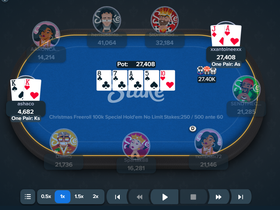
Space KO, which we refer to as Jackpot PKOs, combines the progressive knockout (PKO) format with randomized bounty payouts. Unlike traditional PKOs, where a player’s bounty grows as they eliminate opponents, Space KO allows players to win potentially huge bounties from the very first hand. It also borrows an element of mystery bounty tournaments, but players do not have to wait until reaching a designated stage of the tournament to collect a randomized reward.
The format has continued to grow over the past 18 months, with Winamax increasingly filling its tournament schedule with Space KO events. Its success has also prompted competitors to take notice.
In France, Betclic launched Smash KO, a format clearly inspired by Winamax’s offering, while Space KO itself has continued to set records, including generating a €1 million prize pool in a tournament with an €80,000 guarantee.
The latest development came when GGPoker introduced Ocean KO, its own version of the format, to the international player pool. The launch immediately attracted attention, with one of its tournaments breaking the record for the largest field in an online poker tournament within its first week.
With the format now reaching players well beyond France, the next question is whether it could eventually make its way to the regulated US online poker market.
How Jackpot PKOs Work
Space KO takes the well-known mechanics of a progressive knockout tournament and adds a randomized bounty system. In a traditional PKO, part of each tournament buy-in goes toward a bounty on every player. When a player eliminates an opponent, they collect part of that opponent’s bounty, while the remaining portion is added to their own. As a result, bounties generally grow as players accumulate eliminations.
Space KO changes the equation by introducing the possibility of much larger, randomly generated bounties. Instead of every elimination producing a reward based largely on the opponent’s accumulated bounty, an elimination can trigger a randomized payout, potentially worth far more than the amount a player would ordinarily expect to collect. That means a very large bounty can be won from the very first hand, rather than only after the tournament reaches a designated mystery bounty stage.
The format therefore combines the escalating rewards of PKOs with the unpredictable payouts associated with mystery bounties. Players still have an incentive to eliminate opponents throughout the tournament, but the value of an individual knockout can be far less predictable. A player can win a substantial bounty early, making even the opening stages of a tournament potentially lucrative.
That combination distinguishes Space KO from both traditional PKOs and standard mystery bounty tournaments. In the latter, players typically need to reach the designated bounty stage before they can collect randomized rewards. Space KO makes that possibility part of the tournament from the outset, adding another reason to pursue eliminations.
The concept is not entirely new in online poker. Jackpot sit and go tournaments, such as Winamax’s Expresso format, have already demonstrated how randomized prize pools can turn otherwise familiar tournament structures into something different. Space KO applies a similar principle to multi-table knockout tournaments, and its growing popularity has now encouraged another major operator to adopt the idea.
Could It Work in the US?
The recent spread of mystery bounty tournaments across regulated US online poker markets provides a useful comparison. When the format gained popularity internationally, US operators eventually began introducing their own versions.
WSOP Online was among the first to bring mystery bounty tournaments to the US market back in January 2023, followed by PokerStars. BetRivers Poker joined them quite recently, becoming the third operator to introduce the format, leaving BetMGM as the only major US online poker operator yet to follow suit.
Jackpot PKOs could follow a similar path if they establish themselves as a lasting success internationally. The question is whether operators will see enough demand to justify developing the format and whether it can secure the necessary regulatory approvals.
From a technical standpoint, some US operators appear better placed than others to introduce it. PokerStars, which now operates in the US through FanDuel and the iPoker software platform, has demonstrated a willingness to test new tournament formats in international markets. Developing a version of Space KO or Ocean KO would be a potential next step, although there is no indication that such a launch is currently planned.
BetRivers Poker is another operator worth watching. Its poker platform uses in-house software rather than relying on a third-party poker supplier, potentially giving it greater flexibility to develop new formats. Its recent introduction of mystery bounty tournaments also shows that it is willing to expand its tournament offering.
That does not mean either operator is preparing to launch Jackpot PKOs in the US. There is a difference between having the technical capability to develop a format and deciding that it is commercially worthwhile to bring it to a regulated market.
Regulatory approval could be another obstacle. US operators already offer several formats that combine familiar poker mechanics with additional prize elements, including Spin & Go, BLAST, Electric Poker, PKOs, and mystery bounty tournaments. Jackpot PKOs bring elements of these formats together, combining randomized rewards with progressive knockout mechanics.
That combination may be possible to approve, but it is not safe to assume that existing approval for the individual formats would automatically extend to a new variation. Regulators would need to assess the specific rules and payout structure, and the approval process could take time. Even if an operator wanted to launch the format, it might not be able to do so immediately across all the states in which it operates.
Will the Format Work With US Liquidity?
In addition to considering regulatory approval, there is another question worth examining: can Jackpot PKOs attract enough players in a closed, ring-fenced market to make them viable?
Space KO has already found success in France, where online poker liquidity is shared with only a limited number of other countries. Betclic’s decision to introduce Smash KO is also instructive. The operator serves the French market, yet it considered the format worth adding to its own offering. That suggests Jackpot PKOs do not necessarily require a large international player pool to work.
However, the French market has some characteristics that make it different from the US. Online casino gaming is prohibited in France, leaving online poker and sports betting among the principal regulated online gambling products available to players. Tournament formats that offer a different experience from conventional poker may therefore have an advantage in attracting attention.
Winamax’s Expresso jackpot sit and go tournaments have long been a major part of its offering, and Space KO has followed a similar path in multi-table tournaments. Both formats add the possibility of unusually large payouts to familiar poker structures, giving players an additional reason to try them.
The success of Expresso also provides a precedent for formats originating in a national market eventually reaching international operators. Jackpot sit and gos have been adopted by poker rooms around the world, and GGPoker’s decision to introduce Ocean KO shows that a tournament concept developed by a French operator can also find an audience in the much larger international dot-com market.
Still, success in France does not guarantee similar results in the US. The American market is divided among individual states, with operators competing for players within their respective regulated markets. The available player pools vary, and a format that performs well in one jurisdiction may not necessarily generate the same response elsewhere.
The more immediate test is whether Ocean KO can sustain its early momentum on GGPoker. Its record-breaking opening week is an encouraging start, but operators considering a similar launch will want to see whether player interest continues after the initial excitement fades. Wider adoption by international poker rooms would provide a stronger indication that Jackpot PKOs have staying power rather than being a short-lived novelty.
Which US Operators Could Be First?
If Jackpot PKOs become an established feature of international online poker, PokerStars on FanDuel and BetRivers Poker would be among the operators worth watching in the US. Both have demonstrated an appetite for new tournament formats, and their software arrangements could give them the flexibility to explore a variation of the concept.
BetMGM may be a different case. Its poker offering relies on PartyPoker’s software, meaning the introduction of a new tournament format would depend in part on the capabilities and priorities of its platform supplier. The operator has also yet to introduce mystery bounty tournaments in the US, making a move to a format that combines randomized bounties with progressive knockouts less immediate to anticipate.
WSOP Online is another possibility although its forthcoming platform change makes it too early to speculate about the tournament formats it might eventually offer. The operator is preparing for a new platform, and introducing an entirely new tournament structure may not be an immediate priority while that transition is underway.
For now, there is little reason to expect Jackpot PKOs to reach regulated US online poker in the near future. GGPoker’s launch of Ocean KO has brought the concept to a much larger audience, but one operator adopting the format does not necessarily mean others will quickly follow.
The next step is for Ocean KO to demonstrate that its early success can be sustained and for other international operators to decide whether the format deserves a place in their own schedules. If that happens, US operators may eventually take a closer look. But with a fragmented market, regulatory hurdles, and relatively slow adoption of new tournament formats, the journey from an international success to a US launch could take considerably longer.